Why Explore Montenegro Off the Beaten Path?
Every year millions of visitors come to Montenegro and leave with an almost identical experience: Kotor, Budva, Sveti Stefan, maybe a day trip to Durmitor. Those places are beautiful — there is no doubt. But Montenegro is much more than those postcards.
This country, small like a single European canton, hides within it an entire spectrum of landscapes, cultures and histories that most travelers never experience. We are talking about places where English is not heard in restaurants, where a coffee costs one euro and you get a conversation worth thousands in return. Places where mountains descend straight into a lake, where the only sound in the silence is the wind through the pines.
This guide was created after years of exploring the Montenegrin hinterland — from Prokletije in the east to Boka in the west. It is not intended for those seeking an all-inclusive holiday. It is intended for those who want to get to know the real Montenegro.
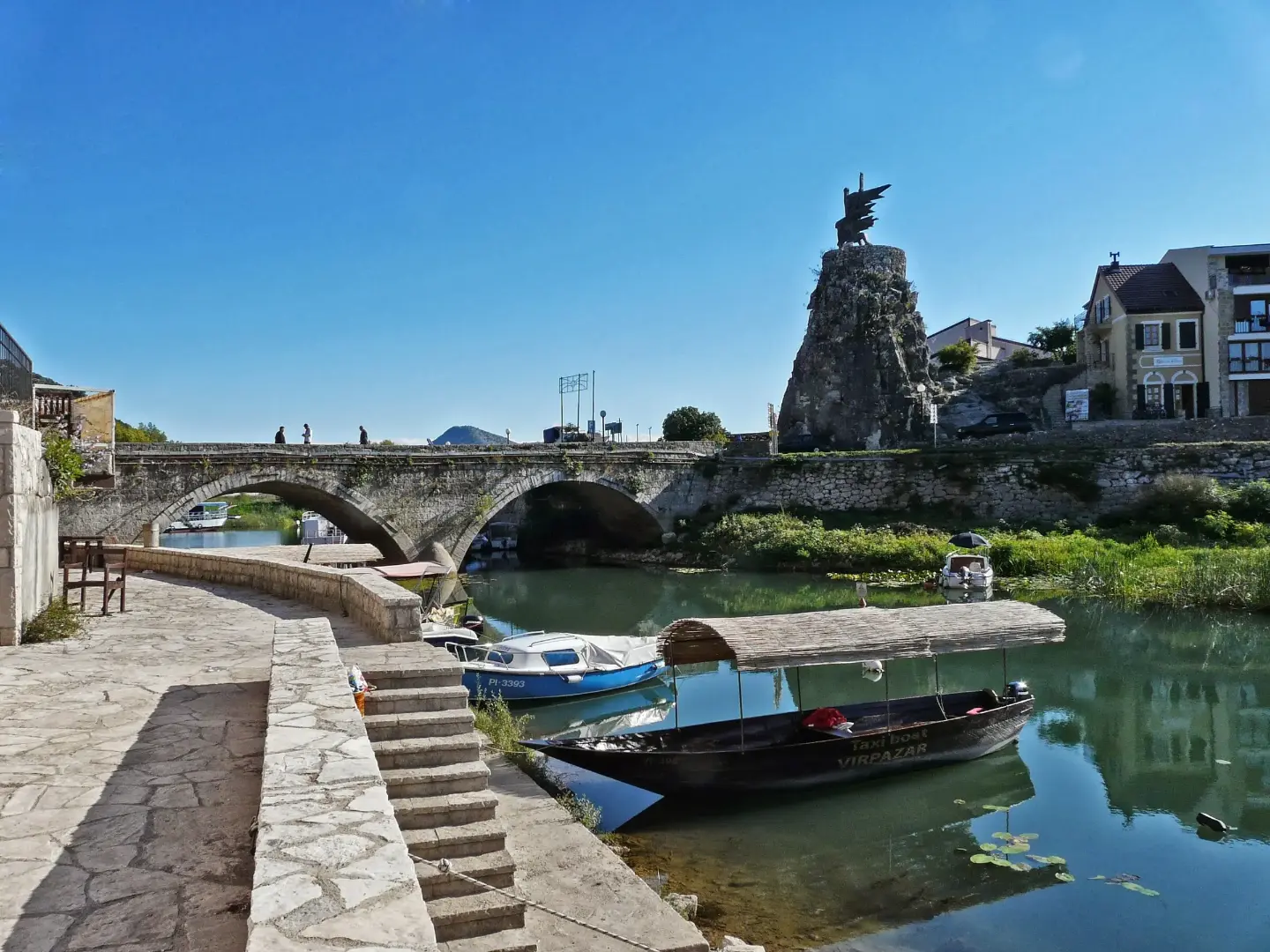
Rijeka Crnojevića: A Quiet Harbor on the Edge of Lake Skadar
If there is one place in Montenegro that can be described as authentic and untouched by tourism, it is Rijeka Crnojevića. Located on the northern shore of Lake Skadar, this small town is named after the Crnojević River and the powerful dynasty that ruled here in the 15th century.
Rijeka Crnojevića is reached from Virpazar — the distance is only about 12 kilometers, but the road winds through karst and forest, so the drive takes about 20–25 minutes. Alternatively, the most dramatic way to arrive is by water from Virpazar — by rented boat or an organized boat excursion. That journey through the reeds and open water of Lake Skadar is breathtaking.
In the village itself there are no hotels in the classic sense, but there are private accommodations and konobas right on the water. A lunch of fish soup, baked carp and local wine should not cost more than 15–20 EUR per person. We recommend visiting early in the morning or late in the afternoon — the light breaking on the calm lake water at those hours is something priceless.
Tip
Practical Tip for Rijeka Crnojevića
Organize a boat trip from Virpazar — the price of renting a small boat starts at 30 to 50 EUR per group. Virpazar is about 40 km from Podgorica via the highway towards Bar, which is about 35 minutes by car.
Gusinje and Prokletije: Mountain Wilderness on the Edge of Montenegro
Gusinje is one of those places that are hard to describe in words and even harder to forget. Situated at the very foot of Prokletije — the mountain massif shared by Montenegro, Albania and Kosovo — this small town has only recently received municipality status, which testifies to its long isolation from the rest of the country.
The road from Plav to Gusinje is only about 12 kilometers long and passes through the Lim River valley, but the landscape itself changes dramatically: the high peaks of Prokletije loom over green meadows, and clear mountain streams cross the road in several places. The drive takes about 20 minutes at normal speed.
The main attraction in the Gusinje area is Ali-Paša's Springs — a system of cold springs that emerge directly beneath the cliffs of Prokletije and feed the Vruja River. The water temperature is a constant 8–10°C throughout the year. The trail to the springs is easy and suitable for all ages, and it passes through a beech and fir forest that provides pleasant shade in summer.
For accommodation, we recommend village houses (apartments) in Gusinje itself or in Plav — prices range from 25 to 45 EUR for a double room. The local cuisine is authentic: kačamak with kajmak, cicvara, spit-roasted lamb. Lunch in a local konoba rarely exceeds 10–12 EUR per person.
Did you know?
Prokletije, also known as the 'Albanian Alps', is home to some of the most dramatic mountain landscapes in the Balkans. Prokletije National Park in Montenegro was only established in 2009 and is one of the youngest protected areas in Europe.
Plav and Plavsko Lake: An Alpine Idyll on the Border with Albania
Plav is a town located at an altitude of about 900 meters, in a valley surrounded by high mountains on all sides. Plavsko Lake, which stretches right next to the town, is one of the rare natural lakes in Montenegro and offers a panorama reminiscent of the alpine lakes of Austria or Switzerland — but without their prices and crowds.
The lake is about 2 kilometers long and slightly less than one kilometer wide. The water is exceptionally clean, and in summer the temperature reaches 22–24°C, making it suitable for swimming. There is a walking path around the lake that is also suitable for cycling.
Plav is about 160 kilometers from Podgorica, and the drive takes between 2 hours 30 minutes and 3 hours, depending on the route and road conditions. The route through Bijelo Polje and Berane is recommended, as it is better than the alternative road through Andrijevica. The Lim River, which originates from Plavsko Lake, follows the road almost all the way to Berane and provides constant visual accompaniment during the drive.
In Plav there are several hotels and guesthouses with prices from 30 to 60 EUR for a double room. The town also has a fortress from the Ottoman period — Plav Fortress — which can be visited free of charge and offers a beautiful view of the lake and surrounding mountains.
Heads-up
Warning for Drivers
Mountain roads towards Plav and Gusinje can be closed or difficult in the winter months due to snow. If you are traveling out of season (October–April), always check road conditions with the local tourist organization or on the AMSCG website.
Šavnik: The Municipality That Preserves the Untouched Wilderness of Durmitor
Šavnik is one of the least visited municipalities in Montenegro, and that very fact is what makes it so special. Situated between Durmitor to the north and Nikšić to the south, this municipality has only a few thousand inhabitants scattered across villages that are barely visible from the road.
The town of Šavnik itself is small and modest — it has no tourist infrastructure in the true sense, but it has an authenticity that is hard to find elsewhere. Local cafés are places where conversations about livestock, weather conditions and village events can be heard. A stranger sitting at a table will be greeted with genuine curiosity and hospitality.
The surroundings of Šavnik offer several exceptional natural locations. The Komarnica Canyon, located in the immediate vicinity, is one of the deeper canyons in Montenegro and is almost completely unknown to the wider tourist audience. The trails along the canyon are unmarked, so it is advisable to hire a local guide — guide prices range from 40 to 60 EUR per day.
Šavnik is about 45 kilometers from Nikšić, and about 40 kilometers from Žabljak. The drive from Nikšić takes about 50 minutes along a winding but paved road.
In Šavnik there is nothing to see — there is something to experience. And that is something completely different.
Bijela and Boka Kotorska: The Quiet Side of the Bay
Bijela is a small coastal town located at the entrance to Boka Kotorska, between Herceg Novi and Risan. While tourists rush towards Kotor and Perast, Bijela remains almost bypassed — and that is precisely its advantage.
The town has a small shipyard complex that adds an industrial note to the otherwise idyllic landscape, but that does not diminish the beauty of the surrounding coves and beaches at all. The beaches in Bijela are pebbly, less crowded than those in Herceg Novi, and the water is exceptionally clean thanks to the constant circulation of seawater in the inner part of the bay.
Villa Jadranska Straža in Bijela is one example of accommodation that offers direct access to the sea with a comfort level not expected in such a peaceful location. Accommodation prices in Bijela are generally 20–30% lower than in Kotor or Herceg Novi, which is an additional advantage for the budget traveler.
Bijela is about 10 kilometers from Herceg Novi (15 minutes by car) and about 25 kilometers from Kotor (30–35 minutes). It is ideal as a base for exploring all of Boka — morning in Perast, midday in Kotor, evening on a quiet terrace in Bijela.
Money saver
Money-Saving Tip
Accommodation in Bijela, Muo or Prčanj instead of Kotor can save you up to 40 EUR per night in the summer season, with almost identical proximity to all the attractions of Boka Kotorska. All these places are 5–15 minutes' drive from each other.
Cetinje: The Old Capital Waiting to Be Rediscovered
Cetinje is a town that carries the weight of history at every step, yet it flies under the radar of most tourists who stop at Lovćen and continue towards Budva. That is a mistake that should not be repeated.
The former royal capital of Montenegro preserves within it a series of museums, embassies from the era of the Montenegrin kingdom, and a monastery that is one of the most important spiritual centers of the Orthodox world in this region. The Cetinje Monastery keeps the relic of the Holy Cross and the right hand of John the Baptist — artifacts that attract pilgrims from across the region.
The town is located on a plateau at an altitude of about 670 meters, which makes it considerably cooler than coastal towns even in July and August. The temperature in Cetinje in the summer months is usually 5–8°C lower than in Budva, which is only 35 kilometers away (45 minutes' drive through Lovćen).
In Cetinje there is also an adventure park on Lovćen that offers a zipline and other forest activities — an excellent option for families with children or a group of friends seeking an adrenaline experience. Entrance to the National Museum of Cetinje costs about 5 EUR, and the Cetinje Monastery is free for visitors.
Accommodation in Cetinje is modest but authentic — guesthouses and private accommodations dominate the offer with prices from 20 to 40 EUR per night. Restaurants in the town center offer traditional Montenegrin cuisine: Njeguši prosciutto, Njeguši cheese, priganice — all at prices significantly lower than in coastal towns.
Berane and Ivangrad: Northeastern Montenegro Without Tourists
Berane — a town that during the socialist period bore the name Ivangrad — is located in the Berane Basin on the Lim River and represents the gateway to northeastern Montenegro. This is a town that lives by its own rhythm, without any attempt to adapt to tourist tastes, which makes it authentic in a way that cannot be simulated.
The surroundings of Berane offer several worthwhile visits. The Đurđevi Stupovi Monastery, situated on a hill above the town, is one of the oldest monasteries in Montenegro and offers a spectacular view of the basin and the Bjelasica mountains. Entrance is free, and the monastery is active — the monks are present and gladly talk with visitors.
Berane is about 130 kilometers from Podgorica (about 2 hours' drive). The town has several hotels with prices from 30 to 55 EUR for a double room. The local cuisine is exceptional: lamb, kajmak, homemade cheese and prosciutto that rivals the one from Njeguši, and the price of lunch in a local restaurant rarely exceeds 10 EUR per person.
From Berane it is easy to organize trips to Biogradska Gora — one of the three primary rainforests in Europe is only 25–30 kilometers away. Entrance to Biogradska Gora National Park costs 4 € (daily ticket), and Biogradsko Lake is one of the most photogenic locations in the entire country.
Good to know
Biogradska Gora from Berane
Combine a visit to Berane with a trip to Biogradska Gora National Park. Entrance to the park costs 3–5 EUR, and a walk around the lake takes about 3–4 hours along a marked trail. Bring your own food — there are no restaurants in the park, only a small café by the lake.
Practical Tips Before You Go
Transport and Logistics
For exploring the hidden places of Montenegro, a rental car is an absolute necessity. Public transport exists, but it is rare and unreliable on shorter routes. Renting a car in Podgorica or Tivat costs from 25 to 50 EUR per day depending on the vehicle category and season.
A vehicle with slightly higher ground clearance (SUV or crossover) is recommended for the roads towards Gusinje, Šavnik and some parts of Prokletije — the asphalt exists, but on certain sections it is damaged or narrow. Fuel is available in all larger towns, but in mountainous areas it is advisable to fill the tank whenever possible.
Podgorica to Plav/Gusinje: about 160 km, 2.5–3 hours
Podgorica to Cetinje: about 38 km, 45 minutes
Podgorica to Berane: about 130 km, 2 hours
Podgorica to Virpazar/Rijeka Crnojevića: about 40–55 km, 40–60 minutes
Herceg Novi to Bijela: about 10 km, 15 minutes
What to Bring
Mountain footwear
For trails towards Prokletije, Ali-Paša's Springs and the Komarnica Canyon — sturdy hiking boots or mountaineering shoes are essential
Warm jacket
Even in summer, at altitudes above 1000 meters the temperature can drop below 10°C, especially in the evening
Cash in EUR
Many smaller restaurants and private accommodations in rural areas do not accept cards
Offline map (Maps.me or OsmAnd)
Mobile signal is weak or nonexistent in mountainous areas — download offline maps before departure
Water and food supplies for the road
In Šavnik, Gusinje and similar places, shops are rare — bring enough supplies for mountain excursions
Approximate Travel Costs
Approximate costs by category
EUR| Item · note | Price |
|---|---|
| Car rental (daily)Depending on category and season | 25–50 € |
| Accommodation — mountain areas (per night)Private accommodation, guesthouse | 20–45 € |
| Accommodation — coast/Bijela (per night)20–30% lower than Kotor | 40–80 € |
| Lunch in a local konobaIncludes food and drink | 8–15 € |
| Entrance to Biogradska Gora National ParkDepending on season | 3–5 € |
| Boat rental (Virpazar)Per group, towards Rijeka Crnojevića | 30–50 € |
| Local guide (mountain terrain)Per day, recommended for the Komarnica Canyon | 40–60 € |
When to Visit?
May and June are ideal for mountain areas — nature is lush, temperatures are pleasant, and there are almost no tourists. July and August are excellent for Plavsko Lake and swimming, but also for Rijeka Crnojevića, which is at its most beautiful during this period. September and October bring golden autumn to Biogradska Gora and around Plavsko Lake — the forest colors are spectacular, and there are no crowds.
The winter period (November–March) is suitable only for experienced travelers who know what they are looking for — some places are inaccessible, but those that are open offer complete authenticity and silence. Cetinje and Berane are accessible throughout the year.
Plan Your Montenegrin Journey
Explore more guides, tips and hidden places of Montenegro on our website. From Boka Kotorska to Prokletije — every corner of this small country has its own story.
View All Montenegro Guides