Travel to Montenegro
Perast and Our Lady of the Rocks: waterfront, palaces and the votive island
Free audio guide

Perast and Our Lady of the RocksWaterfront, palaces and the votive island

Free self-guided audio walk through Perast with a boat hop to the island, no app needed

  • Free · no app needed
  • 4 languagesME · EN · ES · FR
  • Easy walk
walk
120 min
route
⁨2.4 km⁩
stops
11
of audio
14 min
Overview

An audio tour of Perast, the town of captains and seafarers in the Bay of Kotor: the Bujović Palace and the Perast Town Museum, the Zmajević and Smekja palaces, the busts of Marko Martinović and Matija Zmajević, St Nicholas' Church with its fifty-five-metre bell tower, then a boat to Our Lady of the Rocks, the island built by sailors, with Tripo Kokolja's paintings and silver votive plaques. St George's Island is seen from the water. Eleven stops, about two hours including the boat.

How it works

  1. Press play at the first stop

    Nothing to install. Headphones are best; the lock screen and headphone buttons work too.

  2. Walk at your own pace

    Each stop ends with directions to the next one. Tap the next stop when you get there.

  3. Or let GPS guide you

    Choose “Guide me (GPS)” when you start: each stop begins when you arrive – while this page is open on screen.

Route

The walk on the map

The tour starts at Bujović Palace (Perast Town Museum). Tap a number to play that stop.

Stop by stop

11 stops on the way

Listen, or read the full narration of every stop below.

Before you start

Welcome

Welcome to Perast. This is the Travel to Montenegro audio guide to the town of captains and seafarers in the Bay of Kotor. The walk starts at the Bujović Palace, at the entrance to Perast from the Risan side, and follows the waterfront to St Nicholas' Church. From there a small boat takes you to the island of Our Lady of the Rocks, and you see the neighbouring St George's Island from the water. There are eleven stops. The walk itself takes about half an hour; with the boat and the island, allow about two hours. The waterfront is narrow and the odd car still comes along, so keep to the edge. The stone by the sea can be slippery. Leave your car in the car park at the entrance to town. Agree the boat fare on the waterfront before you set off. When you are ready, play the first stop.
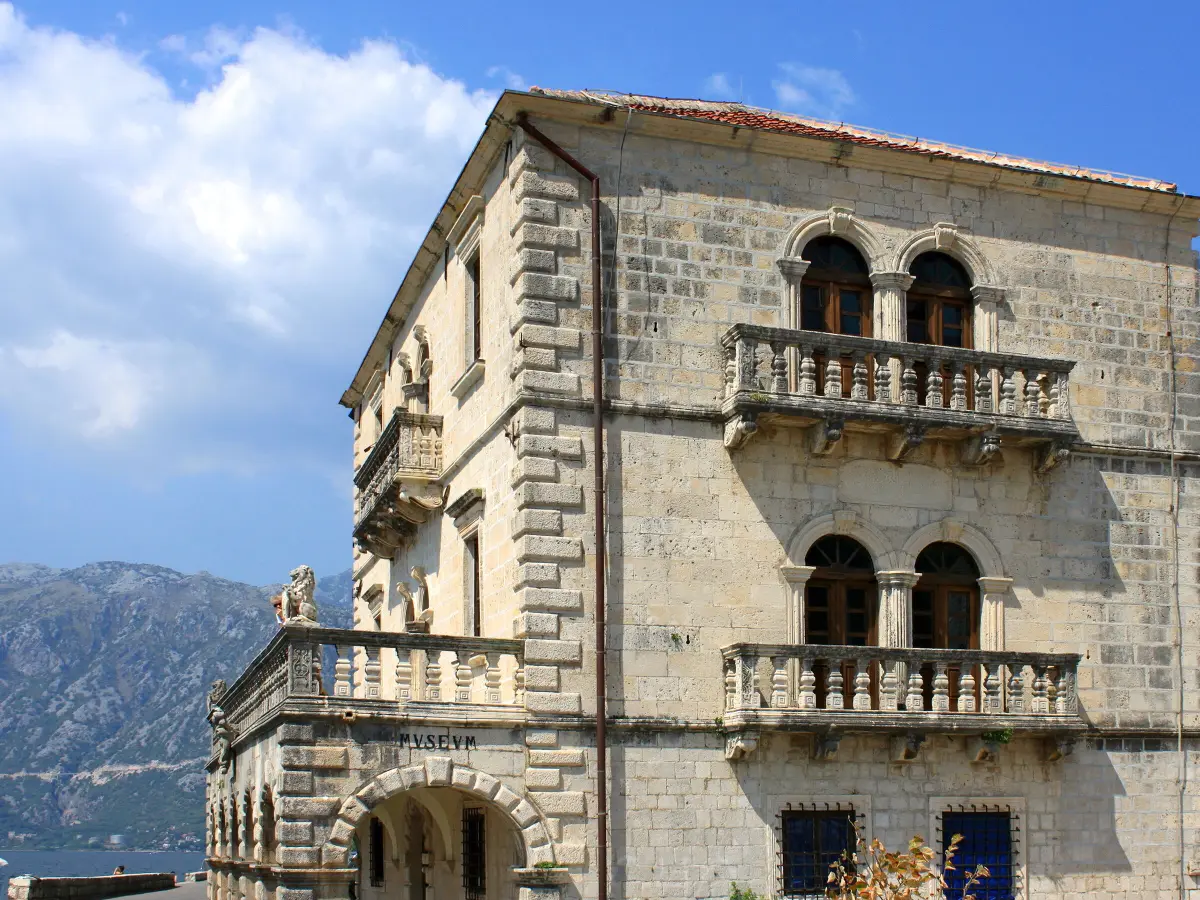
  1. The Bujović Palace on the Perast waterfront, now the Perast Town Museum1
    Stop 11:14

    Bujović Palace and the Perast Town Museum

    In front of you is the Bujović Palace, the first grand house as you enter Perast from the Risan side. Look at the ground floor. Five arches of an open portico carry a terrace, and above them are balconies with stone balustrades. The palace was built in sixteen ninety-four by the Venetian architect Giovanni Battista Fonte. The Venetian authorities put it up as a reward for the town captain, Vicko Bujović, for his courage in the war against the Ottomans at the end of the seventeenth century. The Latin inscriptions on the facade speak of exactly that gratitude. Bujović did not enjoy his palace for long. He was killed in seventeen oh nine, in a feud between Perast families, and you will hear about it once more on this walk. Today the palace houses the Perast Town Museum. It was founded in nineteen thirty-seven and moved here in the nineteen fifties. It holds more than two thousand objects in its maritime, ethnographic and historical art collections. Among the portraits is Vicko Bujović himself, painted by his friend, the artist Tripo Kokolja.

    On to the next stop (⁨120 m⁩): Turn towards the sea and walk left along the waterfront, towards the bell tower in the distance. After about a hundred metres, by a small pier, stop and look up the hill.

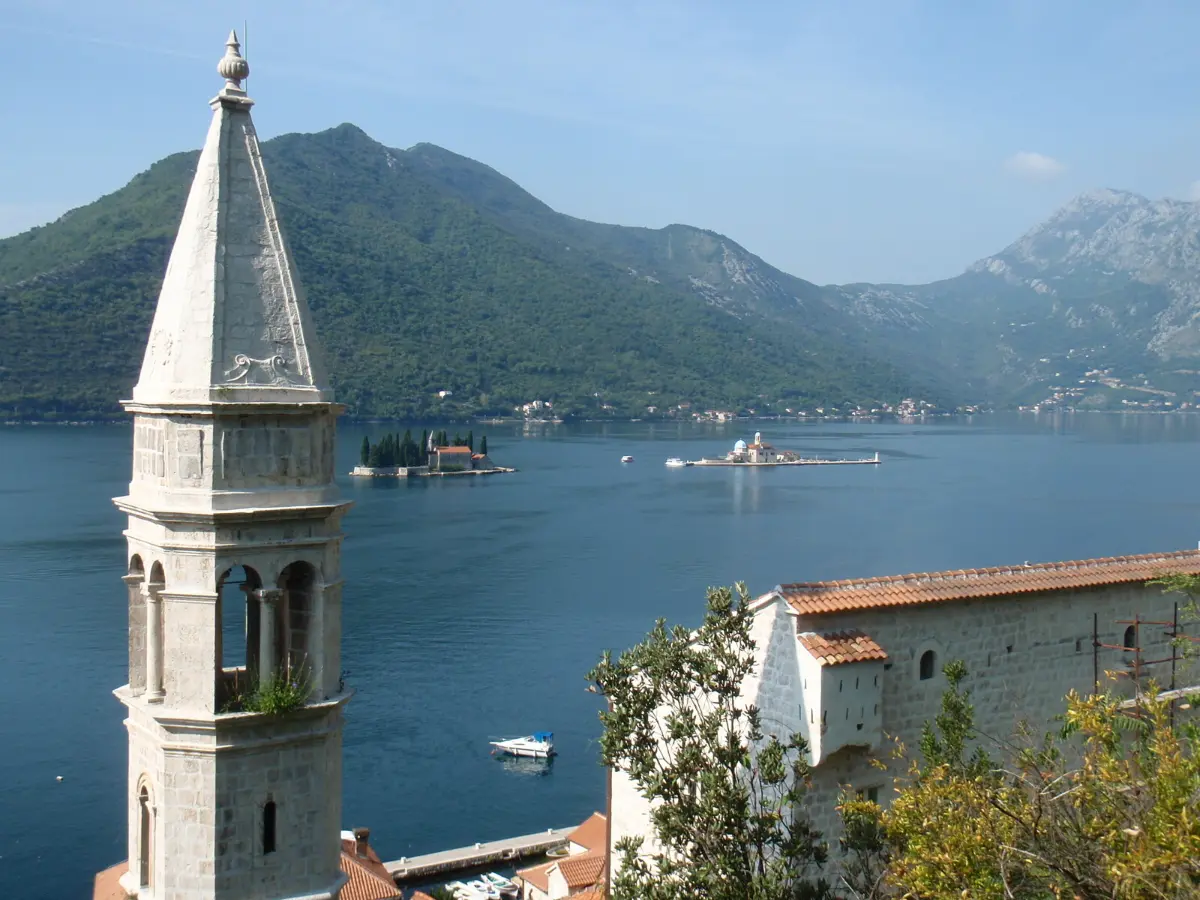
  2. The octagonal bell tower of Our Lady of the Rosary above Perast and the islands in the bay2
    Stop 21:13

    The Zmajević family: the Bishop's Palace and Our Lady of the Rosary

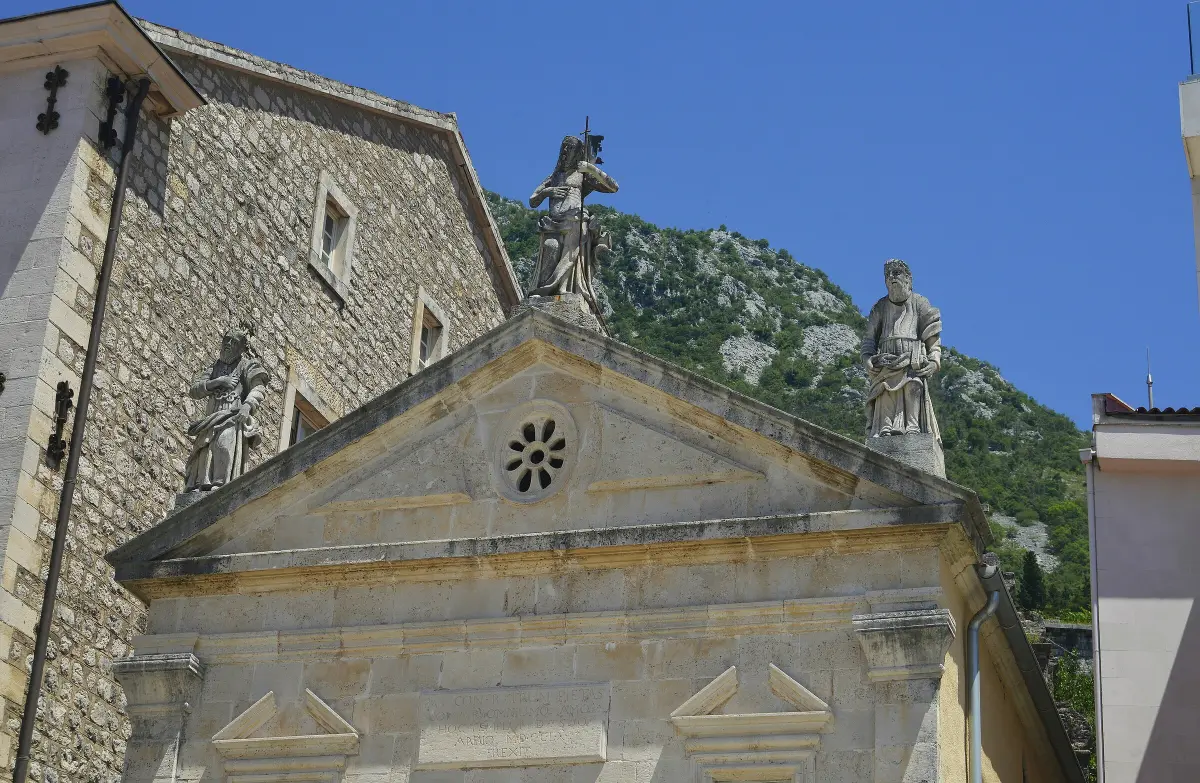
    Look up the hill. Above the waterfront you can see a slender, eight-sided bell tower. That is the Church of Our Lady of the Rosary, and the stone house next to it is the Zmajević Palace, which people in Perast called the Bishop's Palace. Andrija Zmajević was the parish priest here, then Archbishop of Bar, a writer and a poet. The year sixteen sixty-four is carved on the palace. Andrija built the Church of Our Lady of the Rosary in sixteen seventy-eight as his own tomb, and he is buried there. The bell tower was finished in sixteen ninety-four, the year he died. Andrija was also a patron of art. He gave the painter Tripo Kokolja the commission for the church on the island of Our Lady of the Rocks, and he decided himself what the paintings would show. You will see them later, on the island. Later the Bishop's Palace was home to Vicko Zmajević, also Archbishop of Bar and then Archbishop of Zadar. The same family produced Matija, who went much further, all the way to Russia. More about him in a moment. Steep stone steps lead up to the church, so enjoy it from here.

    On to the next stop (⁨70 m⁩): Walk on along the waterfront for about fifty metres, to a large palace with many windows and a small church beside it.

  3. St Mark's Church on the Perast waterfront, next to the Smekja Palace3
    Stop 31:14

    The Smekja Palace and the twelve brotherhoods

    The large palace in front of you is the Smekja Palace, now a hotel. Count Petar Smekja built it in seventeen sixty-four, as the Latin inscription above the entrance says. The facades are of stone from the island of Korčula, and the house has a ground floor, two upper floors and a lookout on the roof. It is described as one of the largest palaces in the Bay of Kotor. To its right is the small St Mark's Church. The palaces of Perast belonged to families grouped into twelve brotherhoods, known here as casadas. The brotherhoods chose the town government, and at the end of the sixteenth century Perast broke away from Kotor and became a self-governing commune. The brotherhoods also held a special honour. Their men guarded the main war banner of the Venetian Republic on the admiral's ship. The standard-bearers were called gonfalonieri. According to the sources, seven of them died defending the banner at the Battle of Lepanto, in fifteen seventy-one. In return, Perast received privileges in trade and shipping from Venice. That is where the money for the palaces you are looking at came from.

    On to the next stop (⁨150 m⁩): Continue along the waterfront to the south-east for about a hundred and seventy metres, to a small square with three bronze busts, next to the church with the tall bell tower.

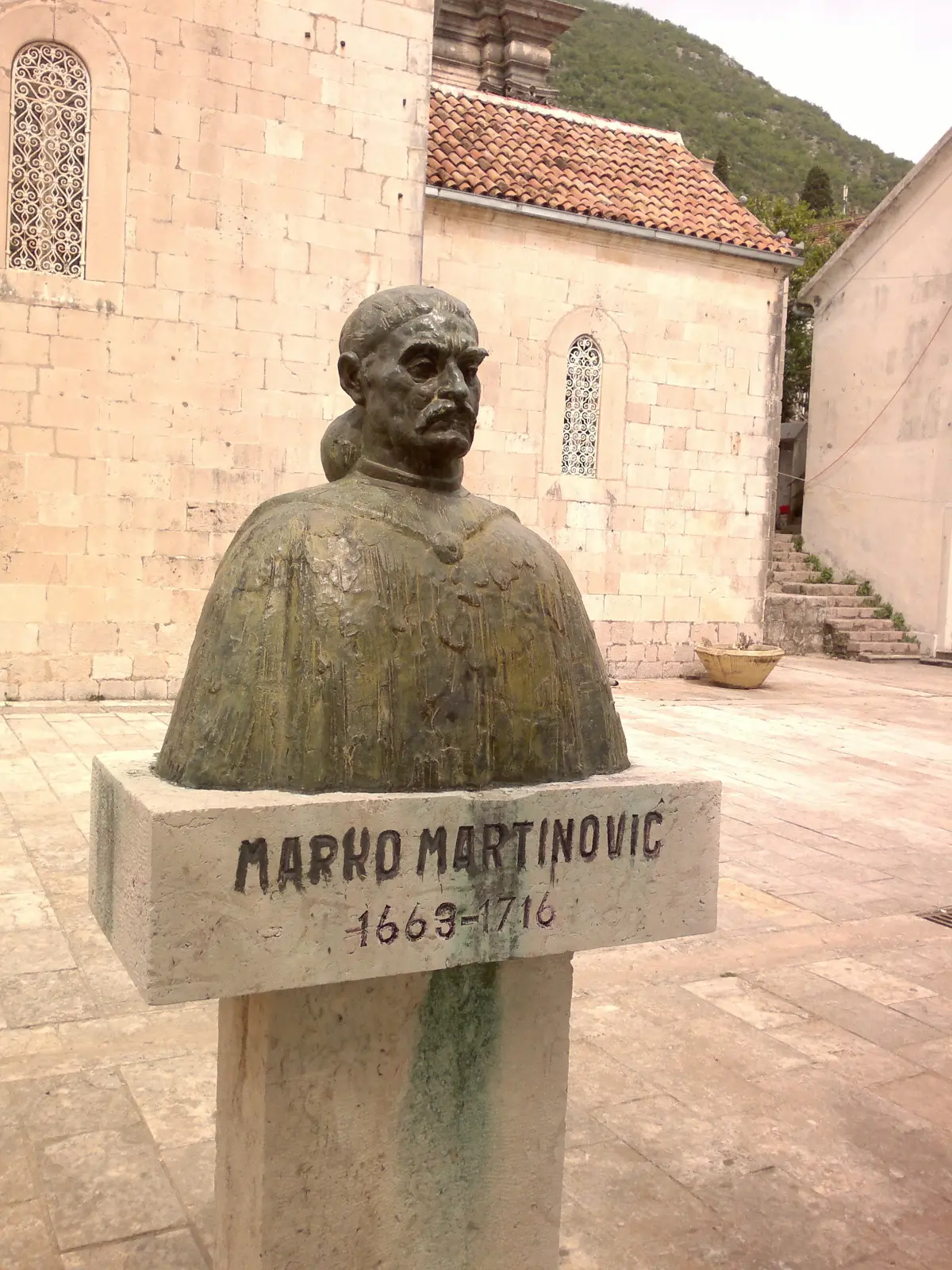
  4. The bust of Marko Martinović on the square in Perast4
    Stop 41:10

    The busts on the square: Marko Martinović and Matija Zmajević

    Here are the busts of three men from Perast. You will meet the painter Tripo Kokolja on the island. For now, the story of the two seafarers. Marko Martinović, born in sixteen sixty-three, was a seaman and a mathematician. In sixteen ninety-eight the Venetian Senate entrusted him with training seventeen Russian noblemen. They had been sent by Tsar Peter the Great, who was building a navy and needed officers who knew the sea. Martinović taught them navigation here, in Perast. He dedicated a treatise on shipbuilding to one of his pupils, Prince Dmitry Golitsyn. The waterfront you came along is named after him. The second bust is Matija Zmajević, the nephew of Archbishop Andrija. He was born here in sixteen eighty. After Vicko Bujović was killed, Matija was accused of being involved, and he left Perast. By way of Constantinople he reached Russia and entered the service of Peter the Great. He fought against Sweden in the Baltic and rose to the rank of admiral. He is buried in Moscow. So one small town gave the Russian navy both a teacher and an admiral.

    On to the next stop (⁨40 m⁩): Take a few steps to the seaward edge of the square and turn towards the church with the tall bell tower.

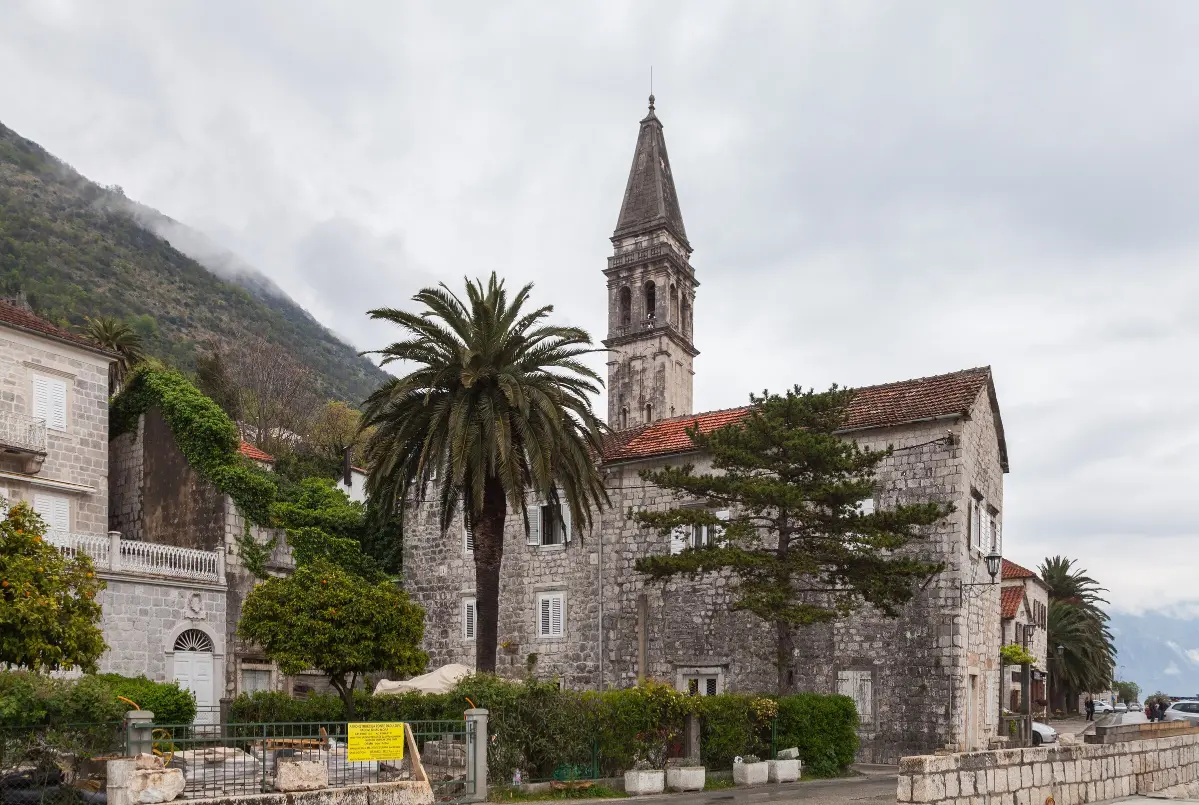
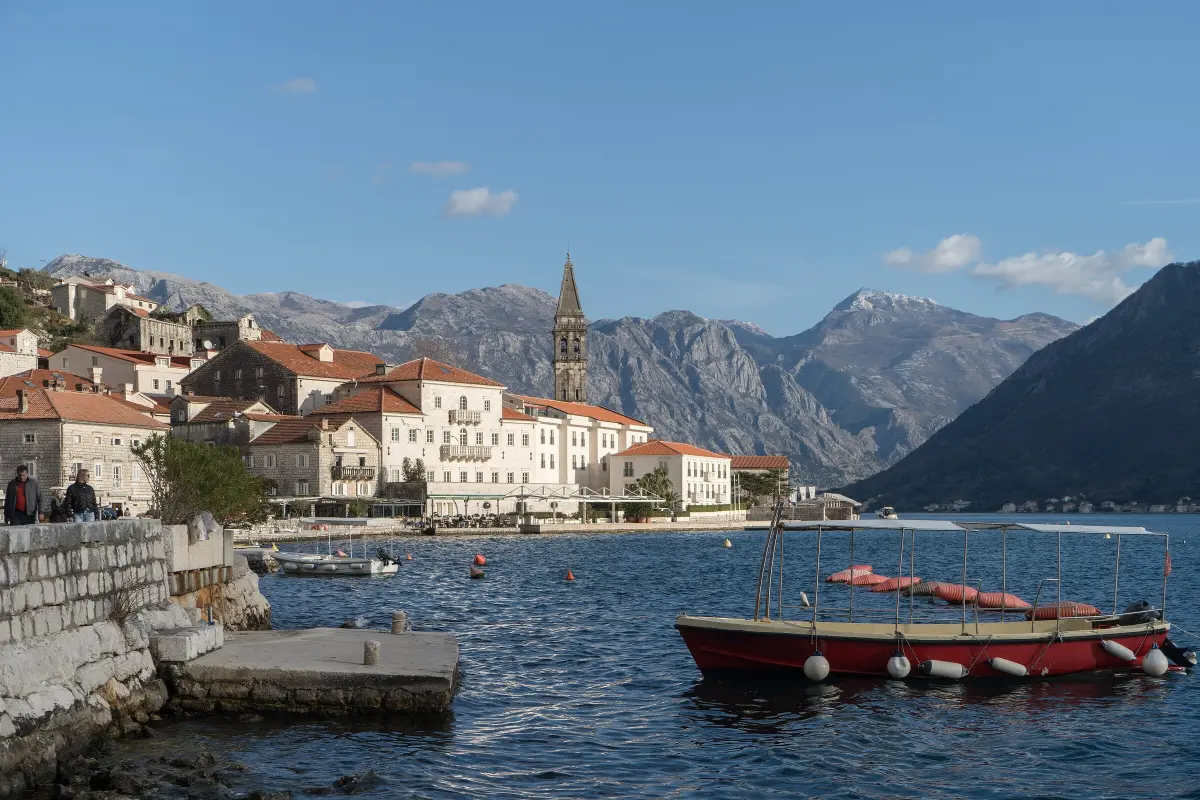
  5. St Nicholas' Church and its bell tower in Perast5
    Stop 51:16

    St Nicholas' Church and its bell tower

    In front of you is the parish church of St Nicholas, the patron saint of sailors, and its bell tower, fifty-five metres high. You can see it from far out on the water. The tower was finished in sixteen ninety-one, in stone from Korčula. It was designed by the Venetian architect Giuseppe Beati and built by Ivan Krstitelj Škarpa. The church in its present form dates from sixteen sixteen. On the facade is an inscription about the victory of the people of Perast over an Ottoman army on the fifteenth of May, sixteen fifty-four. Perast still celebrates that victory every May. Behind the old church rise the walls of a new and much larger church. The foundation stone was laid in seventeen forty, but the building was never finished. Around eighteen hundred the Napoleonic wars brought the work to a halt. Venetian rule in Perast also ended in this church. When Napoleon abolished the Venetian Republic, on the twenty-third of August, seventeen ninety-seven, the people of Perast lowered its flag and solemnly buried it beneath the high altar. Captain Josip Visković gave a farewell speech. His words are still remembered: you with us, we with you.

    On to the next stop (⁨130 m⁩): Continue along the waterfront for about another hundred metres to the south-east, to a stone palace with a balcony right by the water.

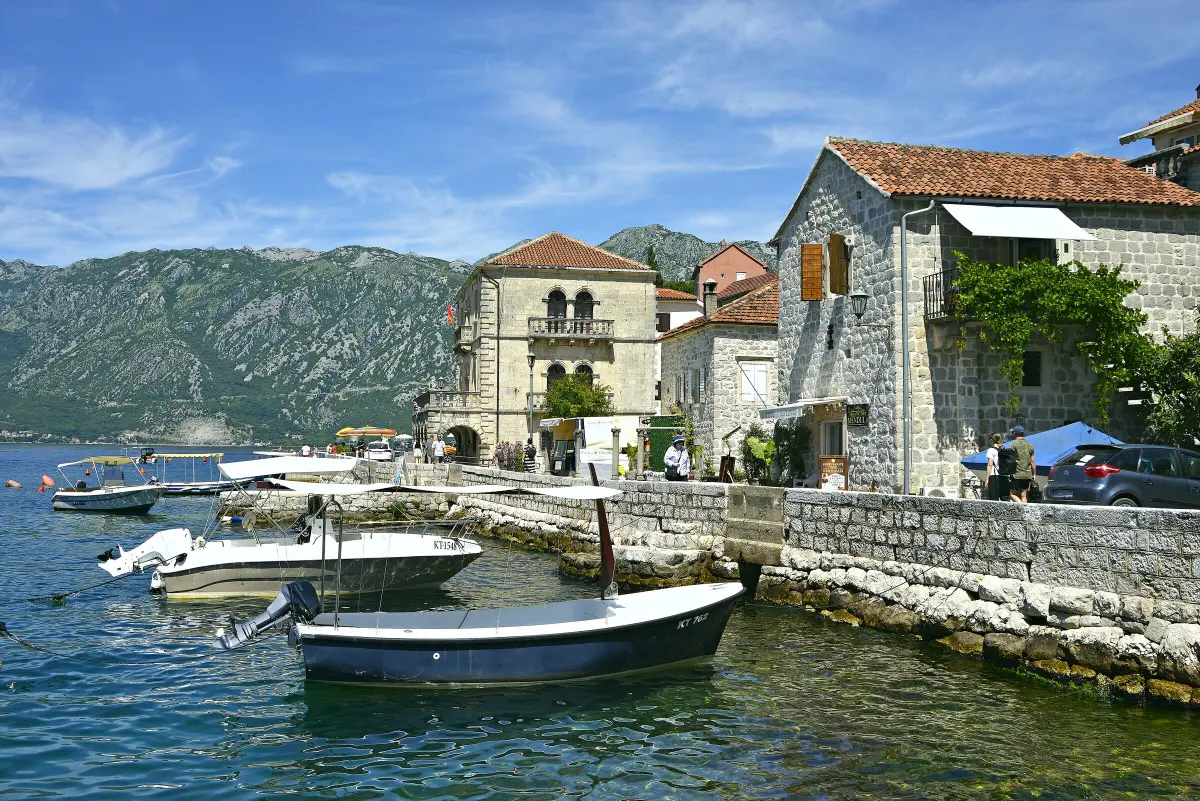
  6. The Perast waterfront with boats and the stone palaces of seafaring families6
    Stop 61:11

    The Visković Palace and the Perast fleet

    This palace belonged to the Visković family, the family of the captain who buried the Venetian flag. The family archive and library are now part of the Perast Town Museum. This part of town, from the square to Pešovo point, is called Luka, the harbour. The old shipyards of Perast were here. The first one is recorded as early as the fourteenth century. In fifteen twelve Perast had sixty ships. At its peak, in the middle of the eighteenth century, the fleet counted about a hundred larger vessels, and the town had about sixteen hundred inhabitants. Ships from Perast sailed all over the Mediterranean and reached England and Holland. The money earned at sea was turned into the palaces and churches you see around you. The fall of the Venetian Republic, and then steamships in the nineteenth century, brought that rise to an end. Today Perast is a quiet place of just over two hundred people. In the harbour quarter there are palaces of other seafaring families as well, among them Balović, Bronza and Mrša.

    On to the next stop (⁨440 m⁩): Walk back along the waterfront to St Nicholas' Square. Small boats and water taxis to Our Lady of the Rocks wait along the shore. Agree the fare and the return time before you leave. When the boat sets off, play the next stop.

  7. Perast and the bell tower of St Nicholas seen from the sea7
    Stop 71:04

    From the boat: Perast between two bays

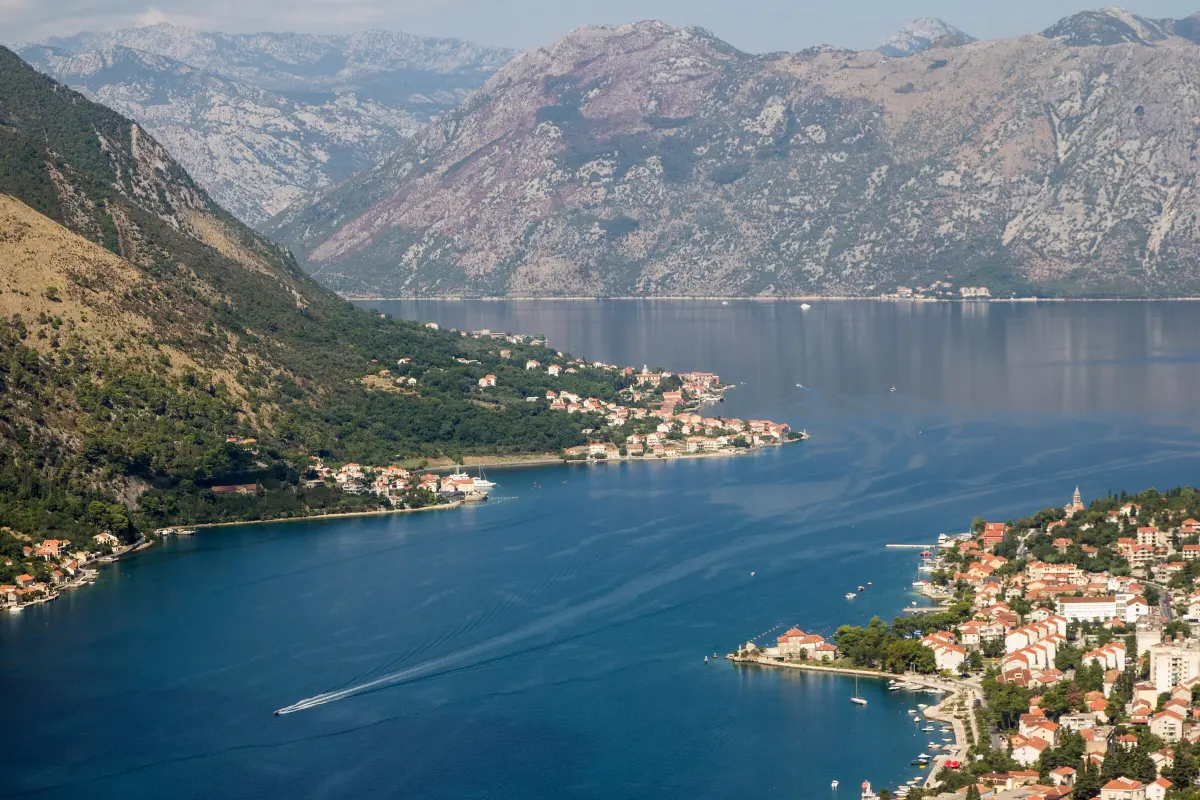
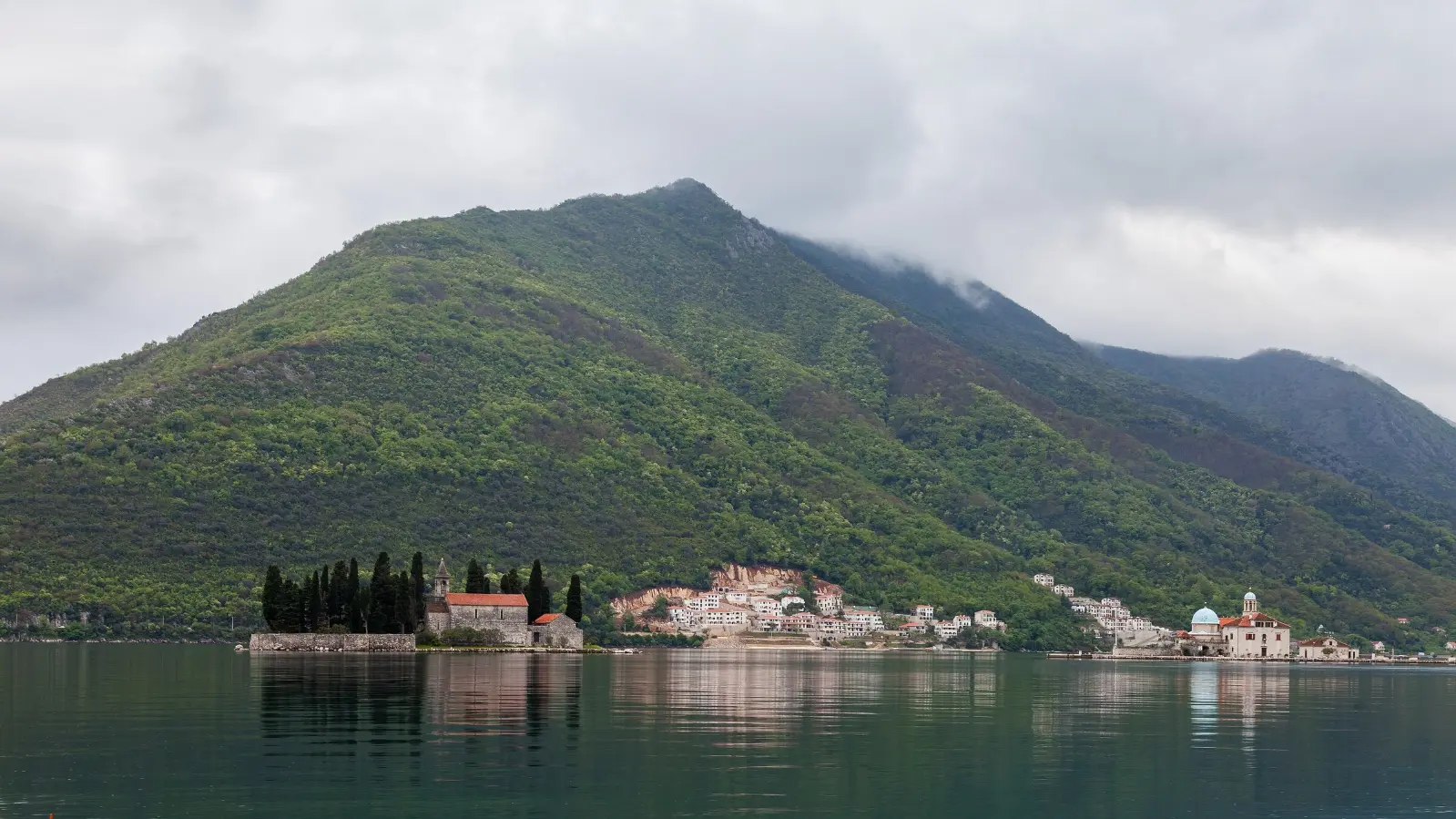
    As the boat pulls away from the shore, look back at Perast as a whole. The town lies at the foot of St Elijah's Hill, about eight hundred and seventy metres high. Above the houses, on the slope, you can see the Holy Cross fortress. Perast never had town walls like Kotor. It defended itself with that fortress and a chain of nine towers, built in the sixteenth and seventeenth centuries. The town stands on a headland between the bays of Risan and Kotor, facing the Verige, the narrowest part of the bay. Whoever held this passage controlled the way to Kotor. That is why fighting with the Ottomans and with pirates went on here for centuries. In sixteen twenty-four the town was plundered, and thirty years later the people of Perast held it, a victory they still celebrate today. Ahead of the boat are two islands. On the left, closer, is St George's Island, with its cypresses and stone church. It is natural. On the right, with the blue dome and the round bell tower, is Our Lady of the Rocks, an island made by people. That is where you will land.

    On to the next stop (⁨460 m⁩): When the boat docks at the island, play the next stop.

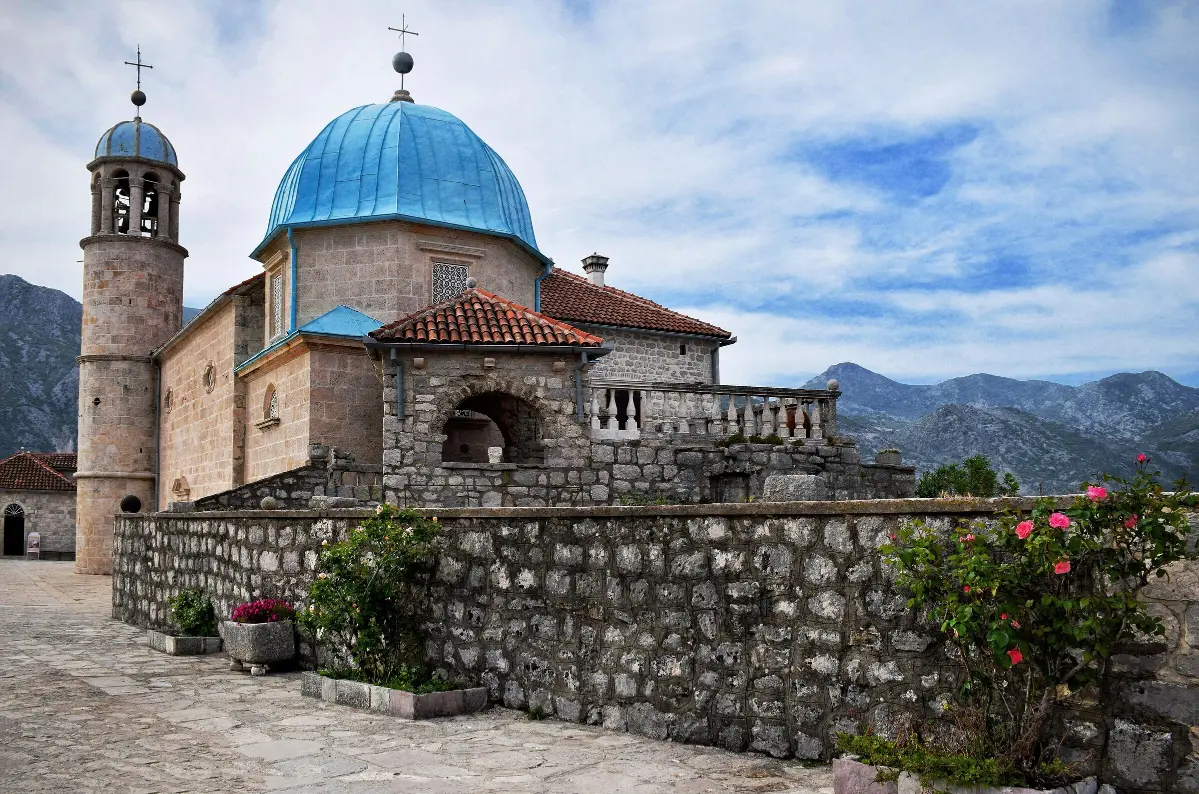
  8. The Church of Our Lady of the Rocks with its blue dome and round bell tower8
    Stop 81:15

    Our Lady of the Rocks: an island of stone and vows

    You are landing on Our Lady of the Rocks. In the old local dialect, the island's name refers to a rock in the sea. According to tradition, on the twenty-second of July, fourteen fifty-two, the Mortešić brothers from Perast found an icon of the Virgin and Child on this rock. They took the icon to Perast, but, the story goes, it returned to the rock. So the seafarers decided to build a church here. For centuries they sank stones and old ships around the rock, until an island rose out of the sea. Today it covers about three thousand square metres. The custom lives on. Every year on the twenty-second of July, at dusk, a procession of decorated boats leaves Perast, tied together and loaded with stones. At the island the stones are thrown into the sea, followed by prayers and songs. The custom is called the fašinada. The church was built in sixteen thirty. It was damaged in the earthquake of sixteen sixty-seven and took its present form, with the eight-sided dome and the round bell tower, in seventeen twenty-five. Landing on the island is free. This is a working shrine, so please don't take photos during Mass.

    On to the next stop (⁨60 m⁩): Walk the few steps to the church entrance and go inside.

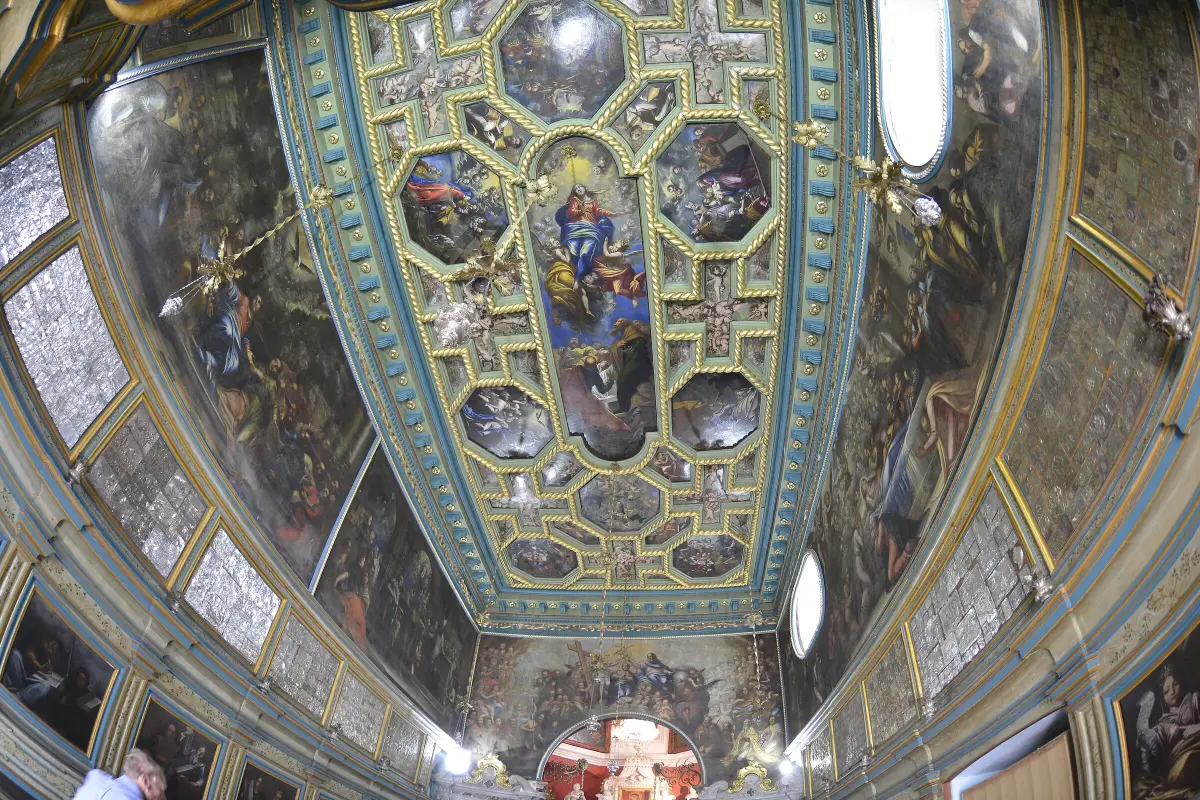
  9. The ceiling of the Church of Our Lady of the Rocks with paintings by Tripo Kokolja9
    Stop 91:03

    Inside the church: Tripo Kokolja's paintings and the silver plaques

    Look up. The ceiling and the walls are covered with paintings by Tripo Kokolja, a Baroque painter from Perast, born in sixteen sixty-one. He painted sixty-eight pictures for this church. They were commissioned by Archbishop Andrija Zmajević, who also chose their subjects: scenes from the life of the Virgin, prophets and sibyls. The largest painting, the Death of the Virgin, is about ten metres long. On the high altar is the icon of the Virgin and Child, the one that tradition says was found on the rock. It is painted on cedar wood and is attributed to the Kotor painter Lovro Dobričević. Now look at the walls around you. They are covered with silver votive plaques, more than two thousand of them. Sailors and their families gave them in thanks for being saved in a storm, in battle or from illness. Many show a ship on the waves. One Latin phrase appears again and again: Votum feci, gratiam accepi. I made a vow, I received grace.

    On to the next stop (⁨20 m⁩): From the church, go through to the museum right next to it. Buy the museum ticket at the entrance.

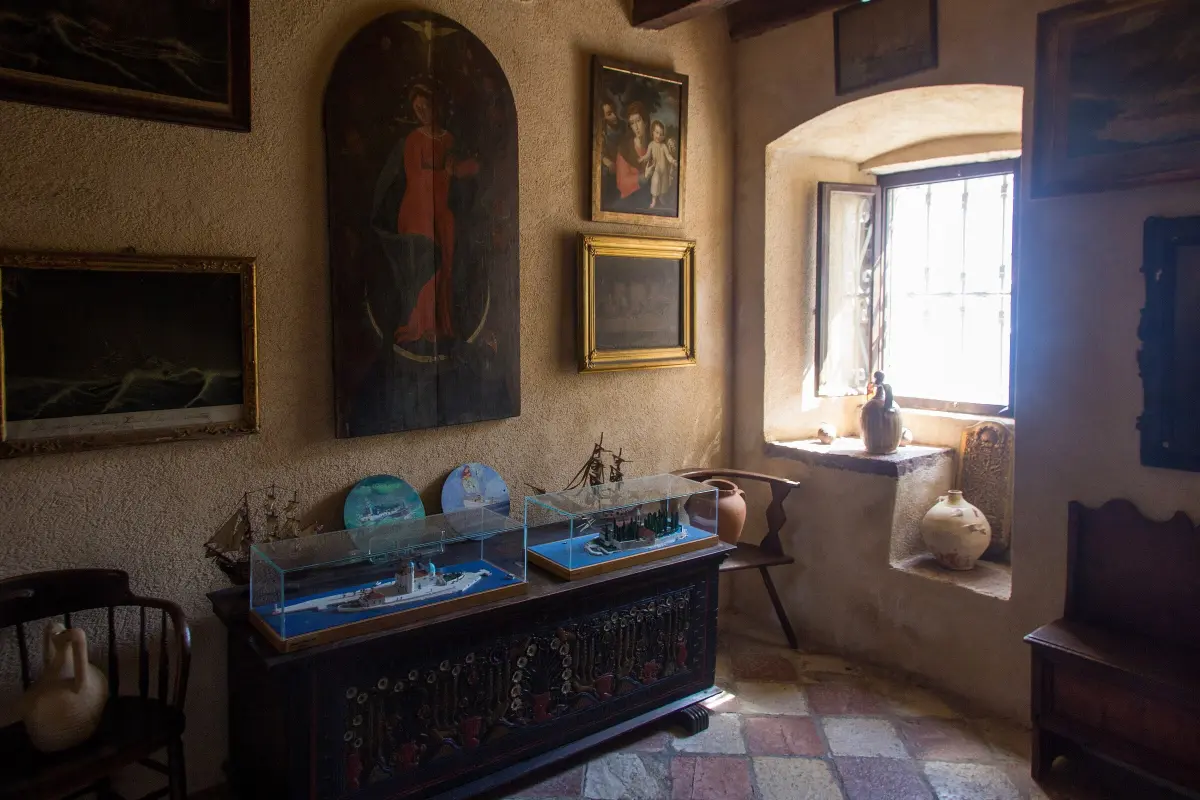
  10. A room of the museum next to the Church of Our Lady of the Rocks, with paintings and ship models10
    Stop 100:52

    The museum: votive paintings and Hijacinta Kunić's embroidery

    The museum next to the church keeps the gifts of Perast's seafarers. The votive paintings show ships in storms or in battle, from which their captains came home. They were made between the seventeenth and the twentieth century. There are also objects from Perast households. One embroidery draws the most attention. It was stitched by Hijacinta Kunić, born Mijović, and signed in eighteen twenty-eight. It shows the Virgin and Child, worked in silk with gold and silver thread. Tradition says she worked on it for many years while waiting for her sweetheart to come home from the sea, and that she used her own hair for the angels' hair. Look closely at the light and dark threads. As you leave, look for the bouquets of flowers above the door. By custom, brides leave them here after their wedding in this church.

    On to the next stop (⁨40 m⁩): Go out to the pier on the south side of the island, the one facing the other island with the cypresses.

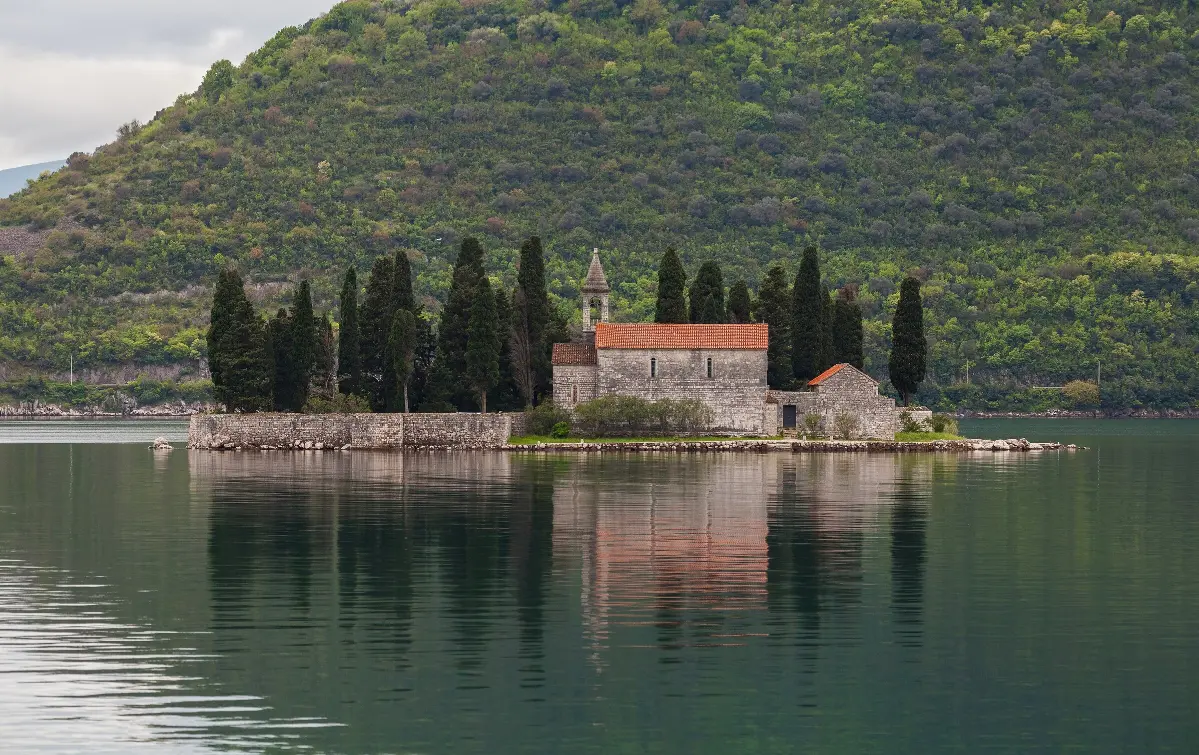
  11. St George's Island with its cypresses and Benedictine abbey11
    Stop 111:02

    St George's Island: the Benedictines' island

    In front of you is St George's Island. Unlike Our Lady of the Rocks, it is natural. On it stands the Benedictine abbey of St George. Its first abbot is recorded in eleven sixty-six. The abbey was supported by the citizens of Kotor, and Kotor noblemen stood at its head. Before Perast grew strong, this island belonged to Kotor and guarded the approach to this part of the bay. Among the cypresses is a cemetery. For centuries the people of Perast, its seamen and its nobles, were buried here. In the middle of the seventeenth century the abbot of this monastery was Andrija Zmajević, the same archbishop from the Bishop's Palace. Visitors usually cannot land on St George's Island. Enjoy it from here, or from the boat on the way back. Look across the water towards Perast as well. From here you can see how the bell towers and palaces line the shore, just as the captains saw them when they came home.

    On to the next stop: When you are ready, take the boat back to Perast. Play the closing message when you reach the waterfront.

At the end

Farewell

This is where our tour of Perast ends. You have walked the waterfront from the Bujović Palace to the old harbour quarter, past the houses of captains, archbishops and admirals, and stood on an island that sailors built stone by stone over the centuries. If you are in the bay on the twenty-second of July, stay until dusk and watch the boat procession to the island from the waterfront. In mid-May Perast celebrates an old victory over the Ottomans. On our website, on the pages about Perast and Our Lady of the Rocks, you will find more detail, places to eat and beaches nearby. Twelve kilometres from here, our audio guide to Kotor Old Town is waiting for you too. Thank you for walking with us. Have a good trip.

Good to know

Before you set off

Every word as text

The full narration of each stop is on this page and in the player, with the spoken sentence highlighted – for noisy streets and for deaf and hard-of-hearing visitors.

Works with the screen locked

Once you have pressed play, the narration keeps going with the screen off; use the lock-screen or headphone buttons for pause and next.

Your location stays on your phone

Location mode is optional and works only while this page is on screen. We never receive or store where you are.

Works offline

Download the tour before you go and it plays without mobile data.

Practical notes

Start: the Bujović Palace (Perast Town Museum), at the western entrance to Perast, coming from Risan. Length: about 0.8 km along the waterfront (Bujović Palace → St Nicholas' Square → Visković Palace → back to the square), then about 0.8 km by boat each way to Our Lady of the Rocks. Duration: about 30 min of walking with listening; about 2 h with the boat and the island. Best time: morning or late afternoon, before and after the excursion boats and coaches. On 22 July at dusk the fašinada boat procession takes place. Accessibility: - The waterfront is flat and paved; residents' vehicles occasionally use it. - Steep steps lead up to the Church of Our Lady of the Rosary and the Zmajević Palace (not part of the tour). - Getting in and out of the boat onto the island's stone pier needs a little agility; the island itself is small and flat. Boat and tickets: small boats and water taxis leave from the waterfront; agree the fare and the return time on the spot (prices change with the season). Landing on the island is free; the ticket for the museum next to the church is sold on the island. The Perast Town Museum charges admission; check opening hours at the entrance. Parking: at the entrances to town; the centre is pedestrian. St George's Island: visitors usually cannot land; it is seen from the boat or from the pier of Our Lady of the Rocks.

Audio guides

More audio guides

Narration: AI-generated voice from our editors' scripts · Map © OpenStreetMap contributors, OpenFreeMap. Map data and sources →

Zora

Your Montenegro travel guide

Hi, I'm Zora

Ask me about places, beaches, food, events or a trip plan — in any language.