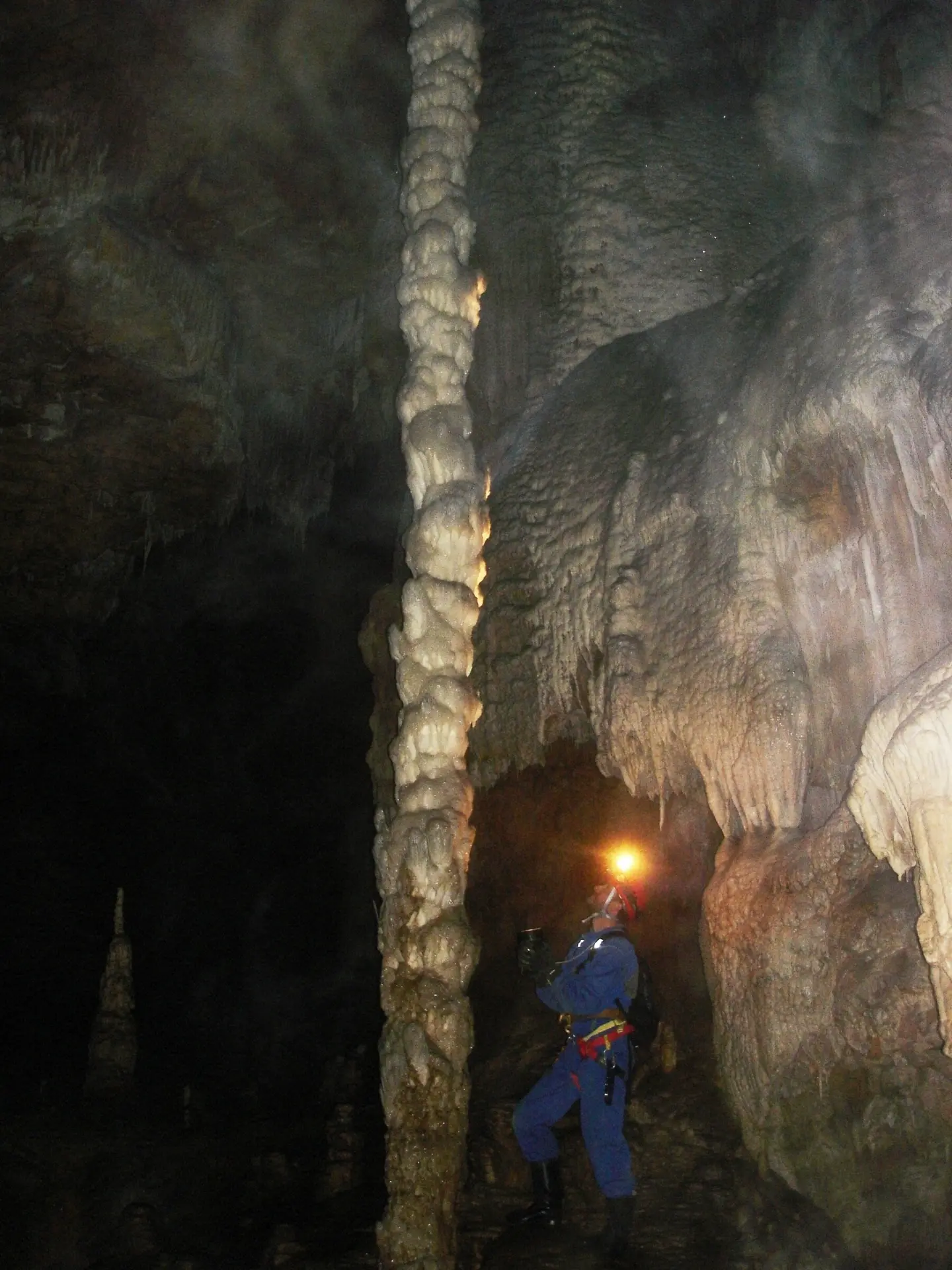
Montenegro's longest cave, in the Đalovića Gorge
Đalovića Cave, also called the Cave above Vražji Firovi, opens on the left side of the Đalovića Gorge, the canyon of the Bistrica river, about 3 km upstream of Podvrh Monastery, which lies 25 km north-east of Bijelo Polje.
Cavers have been exploring it since 1987 and have recorded about 20 kilometres of passages so far, making it the longest known cave in Montenegro. Inside are dozens of lakes, sumps, mazes of passages and the Cathedral chamber with the Monolith stalagmite. The cave is not set up for tourist visits – you can hike through the gorge to the entrance, but only experienced cavers go inside.
The cave is named after four stepped hollows in the limestone below the entrance, filled with water. In spring, when the water is high, the two lower entrances become seasonal springs and the water roars from basin to basin – which is why locals called the place Vražji Firovi, the Devil's Pools. The main entrance is the highest, at 764 metres above sea level.
From the entrance the way leads through the Passage of Lakes, a part of the cave that is still active: it holds 15 permanent and between 20 and 30 seasonal lakes. Sharp slopes and vertical drops make it hard going, and there are few formations here.
On the upper level of the cave some fifteen passages of different sizes form the Great and Small Labyrinth. There is little water here and the most formations – many cavers consider it the most beautiful part of the cave.
The Great Passage is on average about 8 metres wide, in places up to 20; it is about 20 metres high and in places up to 60 metres. In its Cathedral chamber stands the Monolith, a stalagmite about 18 metres tall – the tallest in the cave.
The farthest part of the cave lies behind sumps, flooded passages about 20, 70 and 20 metres long that cave divers have passed. Beyond them are the Great Chamber, the longest lake in the cave and the Crystal Chamber. Exploration in that direction stopped at the fourth sump.
The state has been building a complex with a visitor centre and a cable car from Podvrh Monastery to the cave entrance. Work stalled in 2021 after an unauthorised breakthrough of an entrance. According to the Ministry of Public Works (June 2026), the substation and power line for the visitor centre are finished and work on the cable car continues. The cave is not yet open to tourists and no opening date is known.
Mountains
A forest trail from Podvrh Monastery along the Bistrica, past the Juriško spring, to Vražji Firovi.
On the water
For now the inside of the cave is terrain for experienced cavers with equipment and for divers in the sumps.
Culture
The Church of St Nicholas from 1606 at the mouth of the gorge, with frescoes by the priest Strahinja of Budimlja.
The Bistrica canyon, up to about 600 metres deep, protected as a natural monument since 1968.
Canyon · 1.3 km
An 8-kilometre limestone canyon of the Bistrica river near Bijelo Polje, up to about 600 metres deep, with the Juriško spring, Podvrh Monastery and Đalovića Cave.
City · 15 km
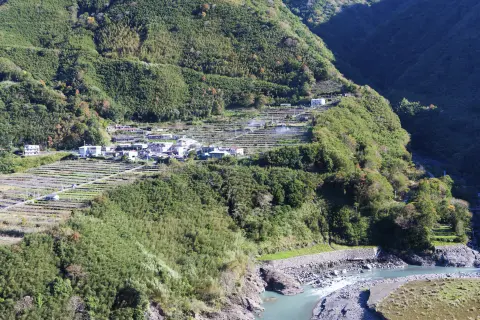
Bijelo Polje is a town on the Lim River, at 575m above sea level, the third largest in Montenegro and the centre of the northern region.
City · 19 km
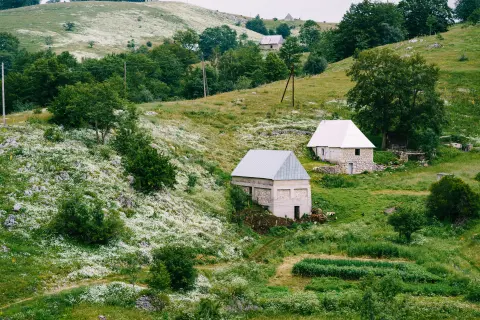
Petnjica is a small mountain town at 724 m above sea level, the administrative centre of the municipality of the same name in the Bihor region of northeastern Montenegro.
Live offers from local hosts on our booking platform. Nothing is charged online – you pay the host on site.
 Farm stay
Bijelo Polje
from €40 / night
indicative – the host confirms
 Farm stay
Bijelo Polje
from €21 / night
indicative – the host confirms
 Farm stay
Bijelo Polje
from €21 / night
indicative – the host confirms
 Farm stay
Bijelo Polje
from €21 / night
indicative – the host confirms
 Farm stay
Bijelo Polje
from €21 / night
indicative – the host confirms
 Farm stay
Bijelo Polje
from €21 / night
indicative – the host confirms
 Farm stay
Bijelo Polje
from €21 / night
indicative – the host confirms
 Farm stay
Bijelo Polje
Price on request
 Farm stay
Bijelo Polje
Price on request
 Farm stay
Bijelo Polje
Price on request
 Camp
Bijelo Polje
Price on request
Monthly averages – Bijelo Polje.
Visitor tip
The nearest airport is Podgorica. Continue to Bijelo Polje by bus, train or car, then by car towards Podvrh.
From Bijelo Polje the road runs via the village of Bistrica to Podvrh Monastery at the mouth of the Đalovića Gorge – about 25 km. From there you walk upstream along the Bistrica to the cave. The other approach goes via Korita to the village of Đalovići (about 48 km from Bijelo Polje) and then on foot down into the gorge.
There is no public transport to the gorge. Buses run to Bijelo Polje from Podgorica and other northern towns; from there continue by taxi or car.
Bijelo Polje is on the Bar – Belgrade railway, so you can reach the town by train. From the station take a taxi or car to Podvrh.
Hiking, walking and cycling routes that start here or pass nearby, with maps and GPX downloads.
Hiking
Cycling · Rožaje
Cycling · Bijelo Polje
Hiking · Biogradska Gora National Park
Cycling · Bijelo Polje · Durmitor National Park
Hiking · Bijelo Polje
Hiking · Bijelo Polje
Hiking · Bijelo Polje
Day 1 · Bijelo Polje, Podvrh, Đalovića Gorge
Not as a show cave. The state project with a cable car and visitor centre is not finished, and no opening date is known. You can hike to the entrance, but only experienced cavers with equipment go inside. For current information contact the Bijelo Polje Tourist Organisation.
Belgrade cavers mapped about 10.5 km of passages by 1990. Later exploration by Czech and local cavers extended the known cave, and the Bijelo Polje Tourist Organisation gives about 20 km. It is the longest known cave in Montenegro, and exploration is not finished.
Most often from Podvrh Monastery, upstream through the Đalovića Gorge – our trail is about 3.3 km long with about 230 m of ascent. The other approach is from the village of Đalovići above the gorge. Either way the walk takes about two hours.
No. The cable car from Podvrh to the cave entrance is being built as part of a state project; according to the Ministry of Public Works (June 2026), work on finishing it and on the power supply continues, and the conditions for putting it into operation still have to be created.
Because of an unauthorised breakthrough of an entrance into the cave. It changed the cave's microclimate and killed a large number of bats, which are protected species in Montenegro. Resuming the work depends on environmental protection measures.
Below the entrance are four stepped hollows in the limestone filled with water. In spring the two lower entrances become springs and the water roars from one into the next – the noise frightened people, so the place was named Vražji Firovi, the Devil's Pools.

